There’s a predictable pattern in home improvement: homeowners spend real money on window treatments for their living rooms and bedrooms, then grab whatever’s cheapest for the kitchen and bathroom because “it’s just a functional space.” Two years later, the cheap option is warping, peeling, or collecting grease and mildew in ways that can’t be cleaned off. And they’re shopping again.
Kitchens and bathrooms are the two rooms where material selection matters most — not least. The conditions inside these spaces are genuinely hostile to the wrong products, and the wrong products fail visibly and quickly.
If you’re looking at a window treatment store in Garden City, comparing options at a blind store near you in Syosset, or exploring moisture-resistant shades for a Manhasset home, this is the practical breakdown you need before you spend anything.
Why Kitchens and Bathrooms Destroy the Wrong Materials
Both rooms create environmental conditions that are fundamentally different from the rest of the house — and they do it repeatedly, every single day.
In the kitchen:
- Steam from boiling and cooking raises humidity in concentrated bursts
- Grease particles travel through the air and settle on nearby surfaces, including window treatments
- Temperature swings between ambient room temperature and cooking heat are frequent and significant
- Windows above the sink are in direct contact with water splash and cleaning spray
In the bathroom:
- Hot showers create sustained high humidity that can last 20–30 minutes after the water stops
- Poor ventilation — common in older homes throughout Jericho, Old Westbury, and Great Neck — concentrates moisture against walls and windows
- Temperature contrast between hot shower air and a cold window surface creates condensation that sits on the treatment
- Privacy requirements mean the treatment stays closed more often, trapping moisture contact longer
Real wood blinds warp. Fabric shades absorb moisture, grow mildew, and hold cooking odors permanently. Standard aluminum blinds corrode at the hardware. None of these are manufacturer defects — they’re predictable outcomes of putting the wrong material in the wrong room.
Best Materials: Faux Wood, Vinyl, and Moisture-Resistant Shades
These three material categories consistently outperform every other option in high-humidity, high-heat environments.
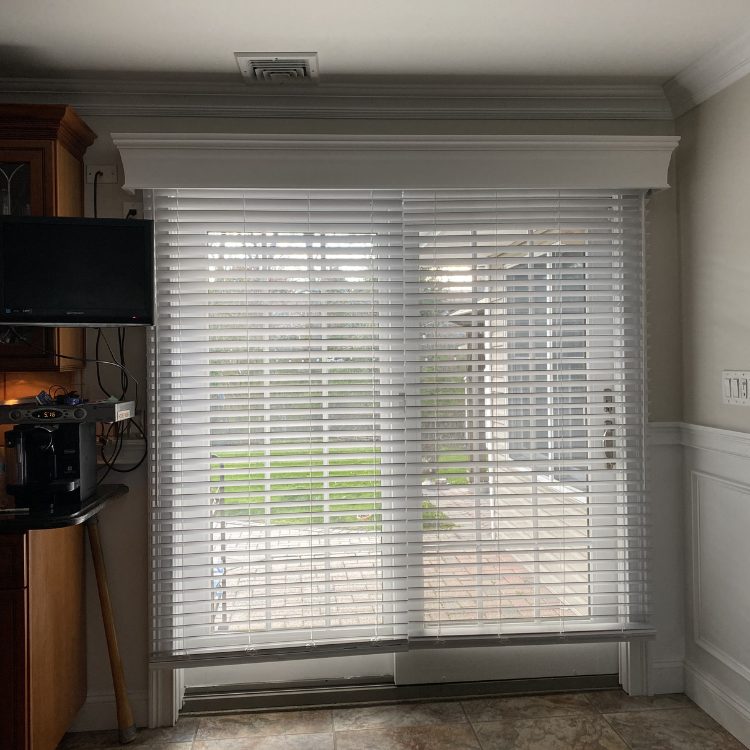
Faux Wood Blinds
- Made from composite wood or PVC, engineered to resist warping, cracking, and moisture damage
- Visually indistinguishable from real wood at normal viewing distance — the warmth and grain pattern read as natural
- Adjustable slats give precise privacy and light control, particularly useful for kitchen windows facing neighbors or a street
- The right choice for kitchen windows and bathroom windows where the look of wood matters but the durability of real wood is inadequate
- Available through major manufacturers including Graber and Alta in finishes that complement both traditional and contemporary Nassau County homes
Vinyl Roller Shades
- Fully waterproof — the only material that can tolerate direct water contact without any degradation
- Wipes clean with a damp cloth in seconds, which matters in kitchens where grease settles on every horizontal surface
- Can be cut to exact widths without affecting structural integrity, making them a reliable choice for non-standard window dimensions common in older homes throughout Garden City and Syosset
- Available in semi-privacy and blackout versions for bathrooms where full privacy is a daily need
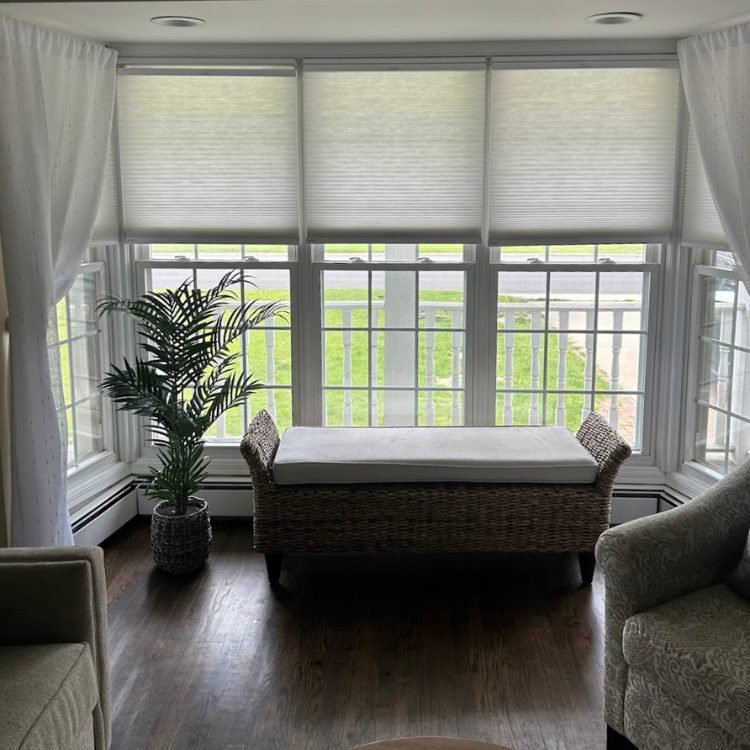
Moisture-Resistant Cellular Shades
- A step up in aesthetics from vinyl rollers while still engineered for humid environments
- The honeycomb construction provides insulation at the window — reducing heat transfer in summer and cold drafts in winter, both meaningful in Long Island’s climate
- Softer in appearance than hard blinds, making them a stronger choice for bathrooms where a spa-like calm is the design goal
- Look for products specifically rated for high-humidity environments — not all cellular shades carry this rating, and the difference in longevity is substantial
Homeowners searching for a window shade store in Great Neck or a window blind store near them in Jericho should ask manufacturers for their specific humidity and moisture ratings — reputable providers like Hunter Douglas, Graber, and Lafayette publish these specifications.
Easy-to-Clean Options for High-Use Areas
Cleanability should be a primary criterion in both rooms — not an afterthought. Treatments that require special care or dry cleaning have no business in a kitchen or bathroom.
What easy-to-clean actually means:
- Wipeable surfaces — faux wood slats and vinyl rollers can be cleaned with a damp microfiber cloth or a mild all-purpose cleaner without any risk to the material
- Non-porous finishes — materials that don’t absorb grease, soap residue, or cleaning products stay cleaner longer and require less effort to maintain
- Removable and rinseable — some vinyl roller shades can be fully removed and rinsed in a shower or with a garden hose without any damage to the fabric or hardware
- Avoid fabric Roman shades in kitchens — they’re beautiful and they belong in living rooms; in kitchens, the fabric pleats collect cooking grease in ways that make them nearly impossible to clean effectively after six months of use
A practical test when evaluating treatments at a window treatment store near you in Manhasset or Old Westbury: ask the provider to walk you through exactly how each product is cleaned, how often, and what happens to the material after repeated cleaning. The answer will tell you more than the product description will.
Why Durability Is a Financial Decision, Not Just a Practical One
The calculation most homeowners miss: a moisture-resistant treatment that costs 30% more than a standard fabric shade and lasts eight to ten years costs significantly less than replacing a cheap treatment every two to three years.
Kitchens and bathrooms are also the rooms where failed treatments are most inconvenient to replace — because the windows are typically in active use zones and installation requires clearing out the sink area, the stove backsplash wall, or the vanity space.
Getting the material right the first time isn’t a premium — it’s an efficiency. Homeowners across Great Neck, Syosset, Garden City, and Manhasset who invest in quality moisture-resistant treatments report that kitchen and bathroom windows become genuinely low-maintenance after installation, sometimes for a decade without any intervention beyond routine wiping.
What Nassau County Kitchens and Bathrooms Specifically Face
Local conditions add specific challenges worth accounting for:
- Older homes throughout Jericho, Old Westbury, and Garden City frequently have smaller bathroom windows with irregular dimensions and limited frame depth — inside-mount options need to be verified for clearance before anything is ordered
- Kitchen windows in North Shore communities often face east or south, meaning they catch both morning light and afternoon heat — solar-resistant coatings on vinyl shades reduce UV fading and heat buildup at the glass
- High-humidity bathrooms with inadequate ventilation — common in pre-1980s construction throughout Nassau County — need materials that can handle sustained moisture exposure rather than occasional splashing
- Renovation-era kitchens with new cabinetry and stone countertops call for faux wood treatments in coordinating finishes that elevate the overall design, not cheap vinyl that reads as an afterthought against expensive materials
Red Flags That Signal the Wrong Choice
Reconsider before committing to any product if:
- A provider recommends real wood blinds for a bathroom without acknowledging moisture risk
- Fabric shades are suggested for above-the-sink kitchen windows without discussing cleanability
- There’s no conversation about the specific humidity conditions in your bathroom or kitchen before a recommendation is made
- Installation excludes measurement, leaving you to self-measure windows with irregular dimensions or obstructions
Bottom Line
Kitchens and bathrooms are the rooms that expose poor material choices the fastest. Faux wood blinds, vinyl roller shades, and moisture-resistant cellular shades are the three categories that hold up — aesthetically and structurally — against the daily conditions these spaces create. Everything else is a temporary solution.
Homeowners throughout Garden City, Manhasset, Great Neck, Syosset, Jericho, and Old Westbury get the most value from a local window treatment specialist who evaluates the actual conditions in each room before recommending a product — not a provider who applies the same solution to every window regardless of where it lives in the house.
Next Steps: Call Long Island Custom Blinds at (516) 580-1958 to schedule your free in-home consultation. A specialist will assess your kitchen and bathroom windows, account for your specific humidity and heat conditions, and recommend moisture-resistant treatments that look sharp, clean easily, and last.