
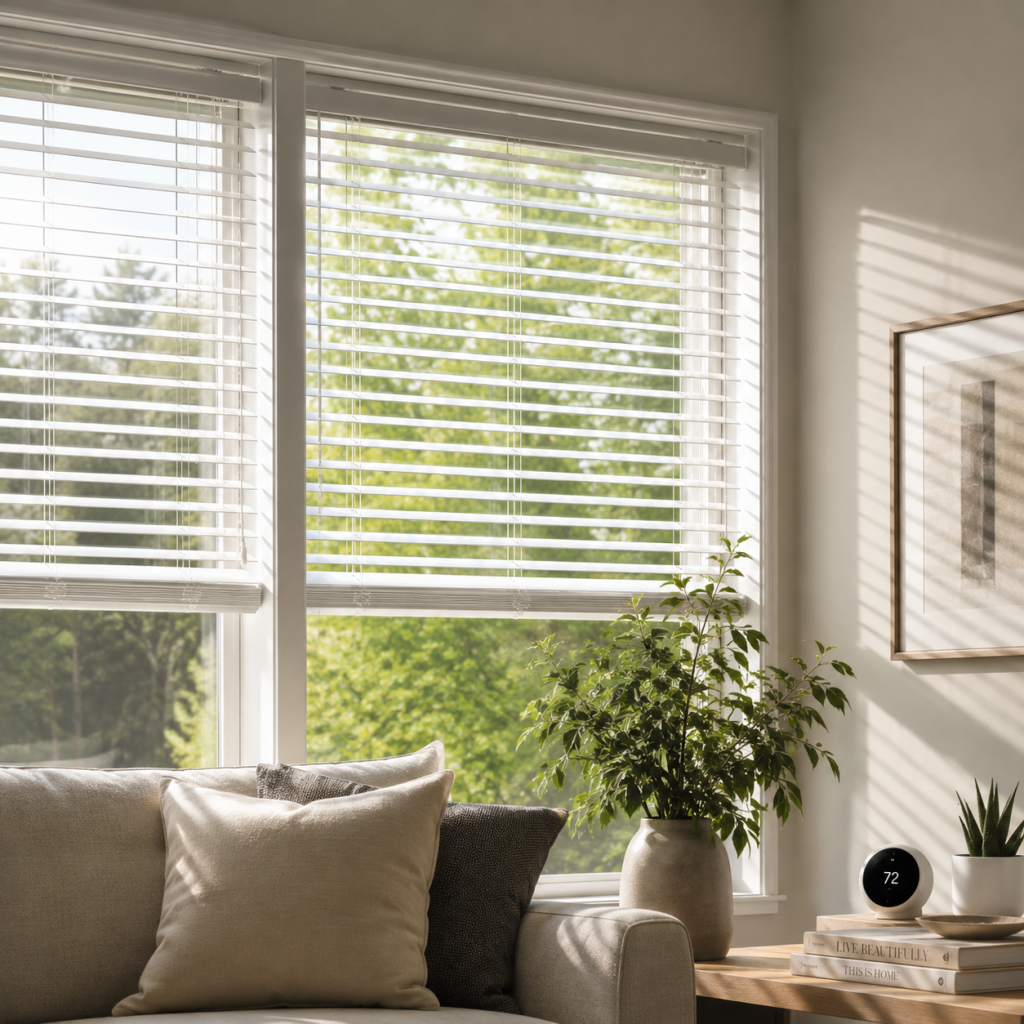
Up to 76% of sunlight hitting a standard window converts into indoor heat, and windows account for roughly 30% of a home’s total heating and cooling energy use, according to the U.S. Department of Energy. For Long Island homeowners dealing with south- and west-facing windows in July and August, the right window treatments can cut heat gain by 45–80%, depending on the product type and installation.
This guide breaks down the five most effective window coverings for keeping heat out, ranked by measured thermal performance, with specific recommendations for Long Island’s humid subtropical summers.
How Windows Turn Sunlight Into Heat
Before choosing a product, it helps to understand what you’re solving. Solar heat gain happens in two stages: shortwave radiation, including visible light and UV, passes through the glass, strikes interior surfaces, and converts to longwave infrared radiation — heat — that cannot pass back out. The glass traps it.
The Solar Heat Gain Coefficient, or SHGC, measures how much solar radiation passes through a window assembly. A standard double-pane window has an SHGC of around 0.65, meaning 65% of solar energy gets through. The goal of any heat-blocking window treatment is to lower that effective SHGC by reflecting, absorbing, or insulating before that energy enters your living space.
On Long Island, the challenge compounds with humidity. Air that is already moisture-saturated holds heat longer, which means once solar energy enters a room, it is slower to dissipate than it would be in a dry climate like Arizona. Keeping it out in the first place matters more here than in arid regions.
1. Cellular Shades — The Insulation Leader
Cellular shades, also called honeycomb shades, trap air in discrete pockets between two or more layers of fabric, creating a dead-air barrier between the window glass and the room interior.
Heat performance: Cellular shades reduce summer heat gain by up to 80% and winter heat loss by up to 40%. A standard double-pane window has a U-Factor of roughly 2.6 W/(m²·K). Adding a single-cell honeycomb shade drops that to approximately 1.6 — a 38% improvement in insulating performance.
Why they work on Long Island: Double-cell, or dual-cell, options are especially effective for homes built before 1990, which make up a significant share of Nassau County housing stock. Many of these homes have older double-hung windows with limited weatherstripping, and cellular shades compensate for the gaps by creating an additional thermal layer inside the frame.
Best rooms for: Bedrooms, living rooms, and any room with windows that face south or west. Blackout cellular shades in a bedroom serve double duty — heat blocking and sleep quality.
Limitations: Cellular shades are fabric-based and can trap moisture if installed in high-humidity spaces like bathrooms. For those rooms, consider faux wood blinds or plantation shutters instead.
Learn more about cellular shades →
2. Solar Shades — Heat Rejection With a View
Solar shades are woven from specialized fabrics designed to reflect sunlight and block UV rays while preserving outward visibility. The key metric is the openness factor — the percentage of the weave that allows light through.
Heat performance: A solar shade with a 3% openness factor blocks up to 97% of UV rays and reduces solar heat gain by 65–75%. Higher openness, such as 5–10%, lets in more light and view but reduces heat-blocking performance accordingly.
Why they work on Long Island: For waterfront homes in communities like Port Washington, Sands Point, and Merrick, where the view is part of the value, solar shades offer protection without sacrificing sightlines. They are also a strong fit for home offices, where glare on screens is a daily frustration from April through September.
Best rooms for: Living rooms with large windows, sunrooms, home offices, and any room where maintaining the view matters as much as controlling heat.
Limitations: Solar shades reduce heat gain from direct sunlight effectively but provide less insulation against conducted heat than cellular shades. On the hottest days, a solar shade alone may not be enough on west-facing glass. Pairing a solar shade with a cellular shade on the same window, using dual-shade brackets, solves this.
3. Plantation Shutters — Built-In Climate Control
Plantation shutters mount within or over the window frame and use adjustable louvers to redirect or block sunlight entirely.
Heat performance: When closed, plantation shutters reduce solar heat gain by approximately 40–50%. Wood and composite materials are natural insulators. They slow heat transfer through the glass by adding mass and an air gap between the louver panel and the window.
Why they work on Long Island: Shutters are a strong match for colonial, Cape Cod, and traditional-style homes common across Nassau County towns like Roslyn, Old Westbury, and Greenvale. They are also moisture-resistant in composite or faux wood versions, making them practical for kitchens and bathrooms where fabric options struggle.
Best rooms for: Kitchens, bathrooms, dining rooms, and street-facing windows where curb appeal matters.
Limitations: Shutters are the highest-cost option on this list, typically running $200–$350 per window installed. The investment makes sense for rooms you use daily and windows that are architecturally prominent.
Learn more about plantation shutters →
4. Roller Shades With Reflective Backing
Standard roller shades with a reflective or metallic backing bounce solar radiation back toward the glass before it converts to heat.
Heat performance: Reflective roller shades reduce heat gain by 50–65%, depending on fabric weight and backing material. White or light-colored fabrics with reflective backing outperform darker options for heat rejection.
Why they work on Long Island: Roller shades are among the most affordable options per window and work well in rooms with multiple windows, such as a living room with a bay window configuration or a sunroom addition. They are also one of the cleanest-looking options for modern and contemporary interiors.
Best rooms for: Sunrooms, large living areas, and bedrooms where light control and heat reduction are both priorities.
Limitations: A standard roller shade without reflective backing provides minimal heat reduction. If you are buying roller shades specifically for thermal performance, confirm the backing material before ordering.
Learn more about roller shades →
5. Motorized Shades on a Schedule
Any of the above options can be motorized and programmed to close automatically during peak sun hours, typically 11 a.m. to 4 p.m. on Long Island during summer months.
Heat performance: Motorization itself does not change the thermal properties of a shade, but consistency matters. A cellular shade that stays open all day because no one is home to close it provides zero heat reduction. Automated scheduling eliminates that gap.
Why they work on Long Island: Many Long Island households are dual-income with no one home during peak heat hours. Motorized shades close at 11 a.m. and reopen at 5 p.m. without any human intervention. The result is measurably lower indoor temperatures when you walk in the door and less strain on your AC system throughout the day.
Hunter Douglas PowerView and Graber motorized systems integrate with most smart home platforms, including Alexa and Google Home, and can be controlled from a phone when you are away.
Limitations: Motorization adds $150–$300 per window to the base cost. The ROI is strongest on south- and west-facing windows where solar exposure is heaviest.
Layering Two Products on One Window
For rooms with extreme sun exposure, such as a west-facing living room with floor-to-ceiling glass or a sunroom addition with windows on three sides, a single window treatment may not be enough. Layering two products on the same window gives you the thermal performance of both, plus flexibility throughout the day.
The most effective pairing for Long Island summers is a solar shade behind a cellular shade, mounted on dual-shade brackets. During the day, lower the solar shade alone. It cuts heat gain by 65–75% while preserving your view. In the late afternoon, when west-facing glass takes the full force of direct sun, lower the cellular shade in front of it. The combined system blocks up to 90% of heat gain, far exceeding what either product delivers alone.
Another practical pairing is sheer drapery with a blackout cellular shade behind it. The sheers diffuse light for a soft daytime ambiance, and the cellular shade handles the heavy lifting on heat and UV when you need it. This combination also reduces heat loss by up to 40% in winter, making it a year-round solution.
The upfront cost of a two-product system is higher, but for rooms that face the worst sun exposure, the cooling savings and comfort improvement justify the investment — particularly if you would otherwise need to run a portable AC unit or close off the room entirely during peak afternoon hours.
Long Island’s Summer Climate and Window Performance
Long Island sits in USDA Hardiness Zone 7a/7b, with summer temperatures regularly reaching the mid-80s to low 90s°F and relative humidity often above 60%. That humidity matters for window performance because moisture-laden air holds heat more effectively than dry air.
When solar radiation heats the air trapped between a window treatment and the glass, that heated air rises and convects into the room if there are gaps at the top or sides of the shade. In a humid climate, the thermal mass of that moist air means more heat transfers per convection cycle. Tight-fitting, inside-mount installations reduce this effect significantly.
Coastal communities, including Merrick, Massapequa, Freeport, and north shore towns like Port Washington and Sands Point, also deal with salt air, which can corrode metal components in window hardware over time. Composite and faux wood materials hold up better in these environments than natural wood or bare aluminum. If you are in a waterfront or near-waterfront home, factor material durability into your product selection alongside thermal performance.
The combination of high humidity, extended daylight hours, and Long Island’s east-west geographic orientation means south- and west-facing windows on the island absorb more cumulative solar energy per summer season than homes at the same latitude in drier inland areas. That context makes window treatment selection more consequential here than national averages suggest.
Which Product Blocks the Most Heat?
| Product | Heat Gain Reduction | UV Block | Winter Insulation | View Preservation | Cost |
|---|---|---|---|---|---|
| Cellular Shades, double-cell | Up to 80% | 99%+ | Up to 40% heat loss reduction | Low, fabric blocks view | $$ |
| Solar Shades, 3% openness | 65–75% | Up to 97% | Minimal | High | $$ |
| Plantation Shutters | 40–50% | High, when louvers are closed | Moderate | Adjustable | $$$ |
| Roller Shades, reflective | 50–65% | Varies by fabric | Low–moderate | Moderate | $ |
| Motorized, any product | Same as base product | Same as base product | Same as base product | Same as base product | Add $150–$300 |
Room-by-Room Recommendations for Long Island Homes
South-Facing Living Room
Solar shades with 5% openness for daytime use, paired with cellular shades for evenings and winter. A dual-shade bracket lets you layer both on one window.
West-Facing Bedroom
Blackout cellular shades are ideal for west-facing bedrooms. These rooms take the full force of afternoon sun from 2–7 p.m. in summer, and a blackout cellular shade handles both heat and light.
Kitchen
Faux wood plantation shutters are moisture-resistant, easy to clean, and adjustable for morning light while cooking.
Home Office
Solar shades with 3% openness help eliminate screen glare without requiring you to sit in a dark room.
Sunroom or Enclosed Porch
Reflective roller shades provide coverage for large glass areas at the lowest cost per square foot.
How to Measure the Impact
Electric Bill Comparison
Compare July–August electric bills year over year. A 10–25% reduction in cooling costs is typical for homes that upgrade from bare or outdated windows to modern cellular or solar shades.
Thermostat Behavior
If your AC runs less frequently or maintains set temperature without cycling as often, the window treatments are reducing heat load.
Surface Temperature
Touch your window sill at 3 p.m. on a sunny day. With effective treatments in place, the sill should feel noticeably cooler than it did before.
Getting the Right Fit Matters as Much as the Right Product
A window treatment that does not fit tightly within the frame allows heated air to convect around the edges, reducing its effectiveness by 20–40%. Inside-mount installations outperform outside-mount for heat control because they seal the gap between the shade and the window frame.
This is where professional measurement makes a real difference. A shade that is 1/4 inch too narrow creates a light gap that also functions as a heat gap. Custom-measured and custom-cut treatments eliminate that problem.
Long Island Custom Blinds measures every window on-site during a free shop-at-home consultation — no guesswork with online measurement tools, no returns for sizing errors.
Frequently Asked Questions
What is the single most effective window treatment for blocking heat?
Cellular shades with a double-cell construction reduce heat gain by up to 80% and provide the best combined performance for both summer cooling and winter insulation.
Do window treatments really lower energy bills?
Yes. The Department of Energy estimates that proper window coverings reduce heating and cooling energy loss by up to 30%. For a Long Island home spending $250/month on summer electric, that is up to $75/month in potential savings.
Are solar shades better than blinds for heat?
Solar shades outperform standard blinds for heat rejection because they are specifically engineered to reflect solar radiation. Standard aluminum or vinyl blinds have gaps between slats that allow heat to pass through.
Should I use different window treatments on different sides of my house?
Yes. South and west windows receive the most direct sun and benefit from high-performance options like cellular or solar shades. North-facing windows get minimal direct sun and may only need light-filtering roller shades.
How much do energy-efficient window treatments cost?
On Long Island, expect $150–$400 per window for quality cellular or solar shades, custom measured and installed. Plantation shutters run $200–$350 per window. These prices include professional measurement and installation through a shop-at-home service.